
A Fortune 500 financial services firm spent $47 million on an AI-powered fraud detection platform last year. The models were state-of-the-art. The infrastructure was cloud-native and scalable. The data pipelines were clean. Six months after launch, the system was catching 12% fewer fraudulent transactions than the legacy rules-based engine it replaced. The problem was not the technology. The problem was that nobody in the organization knew how to interpret the model’s outputs, retrain it when fraud patterns shifted, or integrate its recommendations into existing workflows. Forty-seven million dollars, defeated by a skills gap.
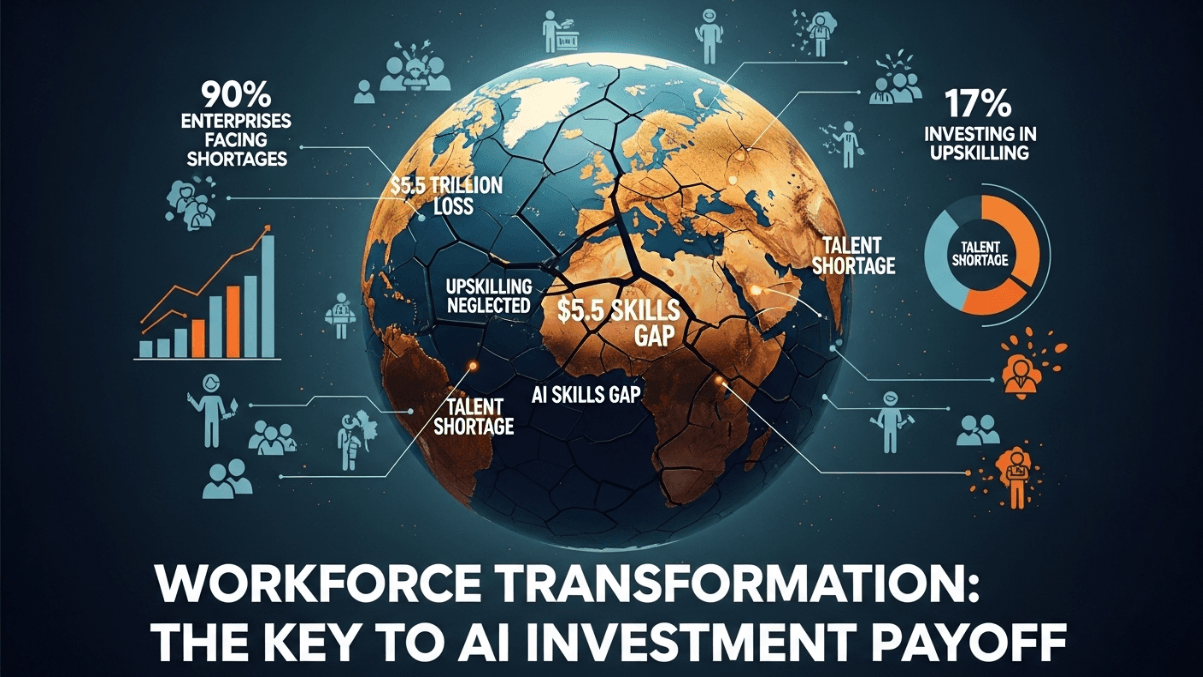
This story is not unusual. It is the norm. IDC projects that skills shortages will cost the global economy $5.5 trillion by 2026 in product delays, quality failures, missed revenue, and destroyed competitive advantage. Over 90% of enterprises will face AI talent shortages this year. And here is the statistic that should alarm every executive reading this: only 17% of employees report that their company is doing anything meaningful to upskill workers in AI-impacted roles. The math is brutal. Organizations are pouring billions into AI infrastructure while starving the one investment that determines whether any of it works: their people.
The AI skills gap is not a vague concern about the future. It is a measurable, accelerating drag on enterprise performance right now.
| Metric | Finding | Business Impact |
|---|---|---|
| Global economic cost of skills shortage | $5.5 trillion by 2026 | Product delays, quality issues, and missed revenue across every industry |
| Enterprises facing AI talent shortages | 90%+ | Virtually every organization competing for the same insufficient talent pool |
| AI talent demand vs. supply ratio | 3.2:1 globally | 1.6 million open positions, only 518,000 qualified candidates |
| Digital transformation delays from skills gaps | Up to 10 months | Nearly two-thirds of organizations experience project slowdowns |
| Workers at medium-term risk of redundancy | 120 million | Employees unlikely to receive the reskilling they need to remain employable |
| Employers proactive about AI training | 33% | Two-thirds of the workforce left to figure out AI on their own |
The gap between what organizations are spending on AI technology and what they are spending on making their people capable of using that technology is not a minor oversight. It is the primary reason 73% of enterprise AI projects fail to deliver ROI.
The instinctive response to a talent shortage is to hire. Post more roles on LinkedIn. Raise salaries. Poach from competitors. This approach is failing, and the data explains why.
AI talent demand exceeds supply at a 3.2:1 ratio globally. There are 1.6 million open AI-related positions and only 518,000 qualified candidates to fill them. The most severe shortages are in the exact disciplines enterprises need most: LLM development, MLOps, and AI ethics all show demand scores above 85 out of 100, while supply sits below 35.
Even when organizations manage to hire, the cost is staggering and the retention is fragile. Senior AI engineers command compensation packages that would have been reserved for VPs a decade ago. And the moment a competitor offers a 20% bump, your hard-won hire becomes someone else’s new team lead. You cannot build a sustainable AI capability on a workforce that turns over every 18 months.
The organizations winning the AI race have figured out a different equation. BCG research reveals that roughly 10% of value from AI comes from the algorithms themselves, another 20% from the technology required to implement them, and the remaining 70% comes from rethinking the people component. The companies treating workforce transformation as a side project are leaving 70% of their AI investment’s potential value on the table.
Not all employees need to become data scientists. But every organization needs a critical mass of people who can do more than paste prompts into ChatGPT. Research from 2026 reveals a widening divide between casual AI users and power users, and the gap has direct financial consequences.
Power users — employees who understand how to structure complex prompts, chain AI tools together, validate outputs against domain knowledge, and integrate AI into repeatable workflows — deliver measurably higher output. They complete tasks faster, produce higher-quality work, and critically, they know when AI outputs are wrong. Casual users, by contrast, often accept AI hallucinations at face value because they lack the domain expertise or critical thinking frameworks to evaluate what the model returns.
The problem is that most enterprise AI training programs are designed to create casual users. They teach employees how to log into a tool and write a basic prompt. They do not teach employees how to think about AI as an augmentation layer for their specific role, how to validate outputs against their professional judgment, or how to build workflows that compound AI’s advantages over time.
70% of workers complete AI training when their employers make it available. The appetite is there. The quality of what is being offered is the bottleneck. Companies investing in role-specific, workflow-embedded AI training — rather than generic prompt engineering courses — are seeing fundamentally different results.
The research is clear on what separates organizations that capture AI value from those that burn through AI budgets. It comes down to four strategic shifts that most enterprises have not yet made.
Future-built companies plan to upskill more than 50% of their employees on AI, compared with 20% for laggards. But volume alone is not the difference. These organizations invest in deep, role-specific training that changes how work gets done, not superficial awareness programs that check a compliance box.
HCLTech demonstrates the scale required: over the past year, almost 80% of their employees have been trained in core skills, with more than 115,000 building digital capabilities and over 116,000 trained specifically in generative AI. This is not a pilot program running in one department. This is a company-wide rewiring of how 200,000+ people work.
Most organizations measure their upskilling programs by course completion rates. This is like measuring a gym membership by how many times someone scanned their keycard at the door. It tells you nothing about whether anyone got stronger.
Leading organizations track business impact metrics: time-to-productivity for employees in AI-augmented roles, error rates before and after training, workflow throughput changes, and whether trained employees are actually integrating AI into their daily work 30, 60, and 90 days after training. AI-driven transformation delivers a 3x faster ROI on new initiatives by accelerating time-to-productivity, but only when training translates into behavior change.
The organizations losing the talent war are the ones treating AI upskilling as an event. Take a course. Get a certificate. Go back to your desk. The organizations winning are building continuous AI learning into their career architecture.
This means AI competency frameworks tied to promotion criteria. Internal mobility programs that let employees move into AI-adjacent roles with structured support. Apprenticeship models where domain experts learn AI skills alongside AI specialists who learn domain context. When 83% of HR leaders say business success now depends more on upskilling employees than hiring new talent, the career path infrastructure becomes a competitive weapon, not a nice-to-have.
The World Economic Forum has identified a critical “AI perception gap” between what employers believe about workforce readiness and what workers actually experience. Employers think training is available and sufficient. Workers report that 67% of their employers have not been proactive about AI training even as AI touches nearly half of all US jobs.
Future-built organizations close this gap by doing something radical: they ask their employees what they need. They run skills assessments that identify specific gaps by role, not generic surveys. They deploy AI-powered skill gap intelligence engines that map individual competencies against role requirements and generate personalized learning paths. And they make training accessible during work hours, not as an evening-and-weekend afterthought that signals the company does not actually value it.
Building an AI-ready workforce is not a single initiative. It requires investment across three distinct layers, each serving a different population within your organization.
Every employee in the organization needs a baseline understanding of what AI can and cannot do. Not how to code a neural network. Not how to fine-tune a language model. But a practical grasp of how AI tools work, where they fail, what they are good at, and what responsible use looks like. This layer covers 100% of your workforce and should take days, not months.
Key outcomes: Employees can identify opportunities to use AI in their work, evaluate AI outputs with appropriate skepticism, follow data handling and security policies when using AI tools, and escalate concerns about AI behavior or outputs.
This is where most organizations fail. Layer 2 training takes the baseline literacy and makes it practical for specific functions. A marketing analyst needs to learn different AI skills than a supply chain manager. A customer service lead needs different capabilities than a financial controller. One-size-fits-all training produces one-size-fits-nobody results.
Key outcomes: Employees can use AI tools specific to their function, build repeatable AI-augmented workflows, validate AI outputs against domain expertise, and measure the impact of AI on their productivity and quality metrics.
This is your smallest but most critical population: the employees who build, deploy, and maintain AI systems. They need deep technical skills in MLOps, prompt engineering, AI security, model evaluation, and system architecture. These are the people you cannot afford to lose, and they are the ones your competitors are trying hardest to poach.
Key outcomes: Technical teams can design, deploy, and monitor AI systems in production, implement responsible AI practices including bias testing and fairness auditing, architect systems that scale, and mentor Layer 2 employees on advanced AI integration.
Theory is useful. Execution is what separates winners from the organizations that will be writing off their AI investments next year. Here is a phased approach that balances speed with sustainability.
The organizations that treat the AI skills gap as someone else’s problem are already paying for it. They just do not see it on a single line item. It shows up as the AI project that took 10 months longer than planned. As the model in production that nobody knows how to retrain when its accuracy degrades. As the $6.8 million initiative that delivered $1.9 million in value because the team using it did not understand how to extract its potential.
The aggregate cost is staggering. With 73% of enterprise AI projects failing to deliver ROI and global AI investment exceeding $680 billion, organizations are collectively destroying hundreds of billions in value every year. And the root cause, in 77% of failed projects, is not technical. It is organizational. It is people.
Meanwhile, 120 million workers globally are at risk of redundancy because they will not receive the reskilling they need to remain employable. This is not just a business problem. It is a societal one. And the enterprises that solve it internally will have a workforce advantage that cannot be replicated by throwing money at recruiting.
Your AI strategy is only as strong as the people executing it. Every dollar spent on AI infrastructure without a corresponding investment in workforce capability is a dollar at risk. The technology is not the bottleneck. The models are not the bottleneck. Your people, and what they know how to do with AI, are the bottleneck.
The enterprises that will dominate their industries over the next five years are not the ones with the biggest AI budgets. They are the ones that figured out, early, that AI transformation and workforce transformation are the same thing. BCG got it right: 70% of the value comes from the people. Start acting like it.
Three things to do this week:
The $5.5 trillion skills gap is not inevitable. It is a choice. And every week you delay making a different one, your competitors get further ahead.
Was this article helpful?


Stay in the know with insights from industry experts.
