
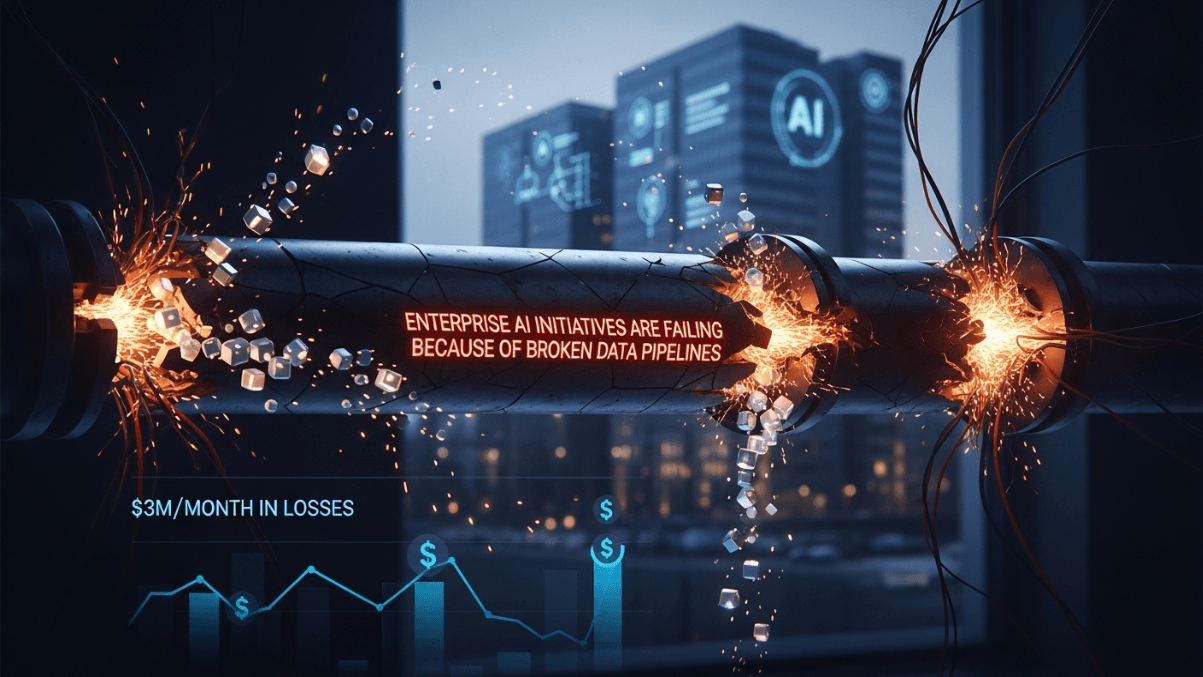
Your data science team just built a model that could save the company $20 million a year. It sits in a notebook, waiting. The pipeline that is supposed to feed it fresh customer data broke again last Tuesday. The fix took thirteen hours. By Thursday, a different pipeline feeding the same downstream table silently started returning nulls. Nobody noticed until the model’s predictions went haywire in production on Friday afternoon. This is not an edge case. This is the default state of enterprise data infrastructure in 2026.
A recent benchmark study of 500+ enterprises found that data pipeline failures cost organizations $3 million per month on average, with a single incident carrying a $1.4 million business impact. Meanwhile, 97% of senior data and technology leaders report that pipeline failures have directly slowed their analytics or AI programs. The AI revolution everyone is investing in has a plumbing problem, and ignoring it is the most expensive decision your organization will make this year.
The Fivetran Enterprise Data Infrastructure Benchmark Report for 2026 surveyed over 500 senior leaders at organizations with 5,000 or more employees. The findings paint a picture that most boardrooms have not yet confronted.
| Metric | Finding | Business Impact |
|---|---|---|
| Monthly pipeline failure cost | $3 million average | $36 million annually vanishing into data infrastructure fires |
| Average failures per month | 4.7 incidents | Nearly one major disruption every week |
| Resolution time per incident | ~13 hours | Senior engineers pulled from strategic work into firefighting |
| Monthly downtime | ~60 hours | Two and a half days of data systems offline every month |
| Data team time on maintenance | 53% | More than half of your data investment goes to keeping lights on |
| Low data maturity organizations | 62% | Nearly two-thirds of enterprises still running fragile, manual pipelines |
| Leaders reporting AI slowdowns from failures | 97% | Virtually every enterprise admits pipeline problems are bottlenecking AI |
Read those numbers again. $3 million a month. That is not a rounding error on an IT budget. That is the cost of a fully staffed AI research lab, burning every thirty days because the data plumbing underneath your most important strategic initiatives is held together with duct tape and hope.
The conventional narrative blames AI project failures on model complexity, lack of talent, or unrealistic expectations. The data tells a different story. Gartner predicts that 60% of AI projects will be abandoned through 2026 due to insufficient data quality, not model quality. Over 50% of generative AI projects are abandoned after proof-of-concept for the same reason: the data feeding them is unreliable, incomplete, or stale.
This is not a model problem. It is an infrastructure problem. And it starts with a fundamental disconnect between how organizations budget for AI and where the actual work happens.
Data scientists spend between 45% and 80% of their time on data preparation and cleaning. Not building models. Not tuning hyperparameters. Not innovating. They are wrangling CSVs, debugging transformation logic, waiting for pipeline runs, and manually validating data that should have been validated three steps upstream. When your $180,000-a-year data scientist spends four days a week doing data janitorial work, you are not running an AI program. You are running an expensive data cleaning service that occasionally produces a model.
The math is punishing. If your data team of 40 engineers and scientists spends 53% of their time on pipeline maintenance at a blended cost of $150,000 per person, that is $3.18 million a year in salary alone spent keeping existing systems from falling over. Add the $2.2 million in direct pipeline maintenance costs that enterprises report, and you are approaching $5.4 million annually before a single new AI capability gets built.
Not all pipeline problems are created equal. After analyzing failure patterns across hundreds of enterprise deployments, five categories account for the vast majority of AI-blocking data infrastructure failures.
An upstream system changes a column name, adds a field, or alters a data type. Nothing breaks immediately. The pipeline keeps running. But downstream models start receiving subtly wrong data, producing subtly wrong predictions that erode trust over weeks before anyone connects the dots. By the time the root cause is identified, business decisions have already been made on corrupted outputs.
Batch pipelines that were perfectly adequate for weekly dashboards become liabilities when AI models need near-real-time data. A fraud detection model running on data that is six hours old is not detecting fraud. It is generating a historical report about fraud that already happened. The gap between when data is produced and when it reaches the model is where business value goes to die.
What starts as a clean ETL process evolves into an undocumented web of dependencies. Pipeline A feeds Pipeline B which has a side branch feeding Pipeline C which was supposed to be deprecated last year but still feeds a critical model that nobody remembers creating. When one node fails, the cascade is unpredictable. Fivetran’s benchmark found that legacy and custom-built integrations have 30-47% higher failure rates than managed alternatives, largely because of this accumulated complexity.
Data arrives on time, in the right format, at the right destination, and is completely wrong. Duplicate records, null values in critical fields, values outside expected ranges, encoding mismatches. Without automated quality checks embedded at every stage of the pipeline, garbage flows downstream at the speed of infrastructure. AI models trained on this data do not fail gracefully. They fail confidently, producing plausible-looking outputs that are systematically wrong.
The data exists. The pipeline works. But the data science team cannot access it because the governance review takes six weeks, the PII masking pipeline has not been configured for this dataset, and the data owner left the company in January. 63% of organizations either lack or are unsure about their data management practices for AI, according to Gartner. When governance is an afterthought bolted onto existing pipelines, it becomes a bottleneck that blocks legitimate access while failing to prevent unauthorized use.
The most dangerous assumption in enterprise AI is that your data infrastructure is ready for what you are asking it to do. The benchmark data reveals a stark maturity divide.
| Maturity Level | Characteristics | AI Readiness | % of Enterprises |
|---|---|---|---|
| Level 1: Fragile | Manual pipelines, ad-hoc scripts, no monitoring, tribal knowledge | Cannot support production AI | ~25% |
| Level 2: Reactive | Some automation, break-fix monitoring, basic scheduling, documented pipelines | Can support simple batch ML models | ~37% |
| Level 3: Proactive | Managed ELT, quality checks, observability dashboards, CI/CD for data | Can support production AI with limitations | ~25% |
| Level 4: Optimized | Fully automated, self-healing pipelines, real-time streaming, embedded governance | Full AI-ready infrastructure | ~13% |
That 62% of enterprises operating at Levels 1 and 2 explains why so many AI initiatives stall. You cannot run a $50 million AI program on Level 2 infrastructure any more than you can run a Formula 1 car on gravel roads. The vehicle is not the problem. The surface it is running on is.
Even if your organization recognizes the pipeline problem, fixing it requires people who are increasingly impossible to hire. The data engineering talent shortage has reached critical proportions.
There are currently 2.9 million unfilled data-related positions globally. U.S. data engineering roles are projected to grow over 20% in the next decade, but the talent pipeline is not keeping pace. Median salaries for data engineers are approaching $170,000, with senior roles in major metros commanding $148,000 to $186,000. San Francisco-based data engineers are among the highest-compensated individual contributors in technology.
The role itself has also expanded dramatically. A data engineer in 2026 is expected to have architectural fluency across cloud-native pipelines, streaming systems, data mesh implementations, governance frameworks, and increasingly, AI infrastructure. Finding someone who can do all of that, and who is not already employed at a company willing to match any offer, is the recruiting challenge that data leaders consistently rank as their most frustrating.
This creates a compounding crisis. Organizations that cannot hire enough data engineers fall further behind on pipeline modernization, which increases maintenance burden, which burns out the engineers they do have, which drives attrition, which makes the hiring problem worse. It is a flywheel spinning in the wrong direction.
The business case for fixing this is not subtle. Organizations that have modernized their data pipelines report returns that make most technology investments look modest by comparison.
| Investment Approach | Measured ROI | Payback Period | Key Benefit |
|---|---|---|---|
| Fully managed ELT adoption | 459% ROI | 3 months | $177,400/year savings per deployment |
| Cloud-based pipeline migration | 3.7x ROI | 6-8 months | Reduced infrastructure overhead and scaling costs |
| End-to-end pipeline modernization | 200-300% ROI | 8-12 months | Measurable cycle time and error reductions in 60-90 days |
| DataOps implementation | Up to 10x productivity | 12-18 months | Engineering time shifted from maintenance to innovation |
The Fivetran benchmark offers the most telling comparison: organizations using fully managed ELT exceed their ROI targets 45% of the time, compared to just 27% for those using DIY or legacy approaches. That is not a marginal improvement. That is nearly double the success rate simply by choosing infrastructure that works reliably.
Modernizing enterprise data infrastructure is not a weekend project. But it does not have to be a multi-year transformation program either. The organizations that move fastest follow a phased approach that delivers value at each stage rather than betting everything on a big-bang migration.
The goal is not transformation. The goal is to stop the bleeding.
With the immediate fires under control, start replacing the infrastructure that keeps catching fire.
Now you are ready to build the data infrastructure that actually accelerates AI rather than constraining it.
You cannot manage a pipeline crisis with anecdotes. These seven metrics give you an objective, ongoing view of data infrastructure health.
| Metric | What It Measures | Target (Mature Org) | Red Flag Threshold |
|---|---|---|---|
| Pipeline reliability | % of scheduled runs that complete successfully | >99.5% | <95% |
| Data freshness SLA compliance | % of datasets delivered within agreed freshness windows | >98% | <90% |
| Mean time to detection (MTTD) | How quickly pipeline failures are identified | <5 minutes | >1 hour |
| Mean time to recovery (MTTR) | How quickly failures are resolved | <30 minutes | >4 hours |
| Data quality score | Composite of completeness, accuracy, consistency, and timeliness | >95% | <85% |
| Engineering time on maintenance | % of data team hours spent on pipeline upkeep vs. new development | <25% | >50% |
| Cost per pipeline | Total cost of ownership including infrastructure, labor, and failure costs | Decreasing quarter over quarter | Increasing without corresponding value growth |
Track these monthly. Share them with leadership. When pipeline reliability drops below 95%, it is not a data engineering problem. It is a business problem that requires executive attention and investment.
The enterprises that will win the AI race over the next five years are not the ones with the best models. Models are increasingly commoditized. Foundation models are available to everyone. Fine-tuning techniques are well-documented. The competitive advantage lies in the proprietary data you can feed those models and the speed and reliability with which you can do it.
Consider two competitors in the same industry, using the same foundation model. Company A has reliable, real-time data pipelines feeding clean, governance-compliant data to its AI systems. Company B has the same model running on stale, inconsistent data that arrives late and breaks often. Company A’s model is not smarter. It is better fed. And in AI, better fed wins every time.
This is why organizations that treat data pipeline modernization as a cost center are making a strategic error. Pipeline reliability is not overhead. It is the foundation that determines whether your AI investments deliver returns or join the 60% of AI projects that Gartner says will be abandoned.
You do not need a twelve-month roadmap to start. You need to take three concrete actions this week.
First, quantify your pipeline failure costs. Pull the data on how many pipeline incidents your team handled last month, how long each took to resolve, and which downstream systems were affected. Multiply by your blended engineering cost. The number will be larger than you expect, and it will get your CFO’s attention faster than any strategy deck.
Second, identify your three most fragile pipelines. Ask your data engineers which pipelines they dread. They know. These are the ones that break on weekends, that require specific tribal knowledge to fix, that everyone wishes someone would rewrite. Start your modernization here.
Third, set a freshness SLA for your most important AI model. Pick one production model and define how fresh its input data needs to be for it to deliver business value. Then measure whether your current infrastructure meets that SLA. If it does not, you have just identified your highest-priority pipeline investment.
The AI data pipeline crisis is not a future risk. It is a present reality costing enterprises $36 million a year in direct losses, multiples of that in missed AI value, and incalculable amounts in competitive positioning. The organizations that fix their plumbing first will be the ones that actually deliver on the promise of enterprise AI. Everyone else will keep building brilliant models that never see production.
Was this article helpful?

Stay in the know with insights from industry experts.
