
The CFO of a Fortune 500 logistics company approved a $12 million annual AI budget in January 2026. By March, the finance team discovered the company was on pace to spend $19.4 million. The overshoot did not come from ambitious new projects or scope creep. It came from the AI systems already in production quietly consuming tokens, spinning up GPU instances, and running inference loops that nobody was monitoring at the cost level. The AI worked exactly as designed. The budget was never designed for how AI actually works.
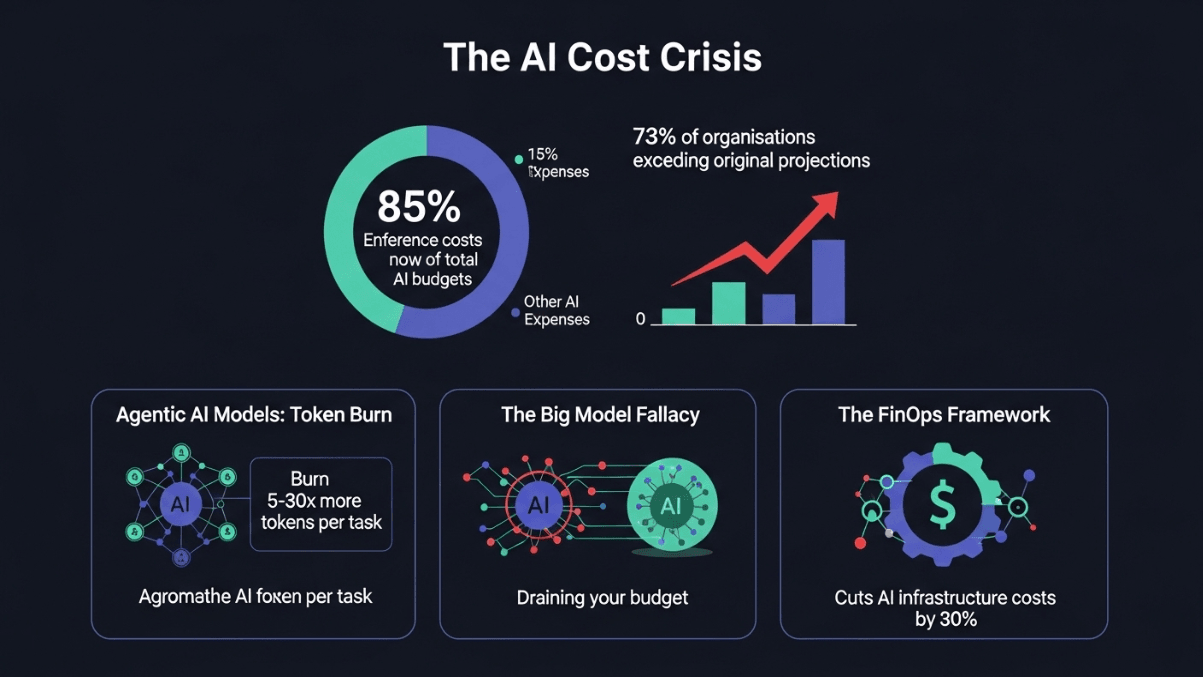
This story is not unusual. The FinOps Foundation’s 2026 State of FinOps Report found that 73% of enterprises report AI costs exceeding their original budget projections, with 80% missing their AI cost forecasts by more than 25%. While boardrooms celebrated pilot successes and production deployments throughout 2025, they overlooked a fundamental economic shift: inference, the cost of actually running AI models in production, now accounts for 85% of the enterprise AI budget. Training got the headlines. Inference is getting the invoices.
For years, the AI cost conversation centered on training. How much compute does it take to build a model? How many GPUs, how many weeks, how much electricity? Those numbers were staggering, but they were one-time costs that could be planned and amortized. Inference is different. Inference is the cost of every single prediction, every generated response, every agentic decision your AI systems make in production, and it runs twenty-four hours a day, seven days a week, at a scale that compounds with every new user and workflow.
Three forces are driving inference costs to levels that are catching enterprise finance teams off guard:
The enterprise shift toward agentic AI, systems that can plan, reason, and execute multi-step tasks autonomously, has fundamentally changed the token economics of production AI. Gartner’s March 2026 analysis confirms that agentic AI models require 5 to 30 times more tokens per task than standard chatbot interactions.
Consider what happens when an AI agent processes a customer support ticket. A traditional chatbot receives a query and generates a response: one input, one output, a few hundred tokens total. An agentic system reads the ticket, searches the knowledge base, checks the customer’s account history, evaluates the warranty status, drafts a response, reviews it against policy guidelines, revises it, and then sends it. Each of those steps consumes tokens. Some steps trigger sub-agent calls that consume their own tokens. The agent might reason through three possible approaches before selecting one, and every discarded approach still costs money.
With 74% of companies planning to deploy agentic AI within two years according to Deloitte’s 2026 State of AI report, the organizations that do not model these token economics before deployment will be the ones scrambling to explain budget overruns to the board.
Retrieval-Augmented Generation has become the default architecture for enterprise AI applications that need access to proprietary data. The approach is sound: retrieve relevant documents, inject them into the model’s context, and generate grounded responses. The cost problem is that most enterprise RAG implementations are not optimized for what they retrieve or how much context they inject.
A typical RAG query at an enterprise with a large knowledge base might retrieve 15 to 20 document chunks, each containing 500 to 1,000 tokens, even when only two or three chunks are genuinely relevant to the question. That means every single query is paying for 10,000 to 20,000 tokens of context that adds cost without adding value. Multiply that by tens of thousands of daily queries across customer support, internal search, and document analysis workloads, and RAG bloat becomes one of the largest hidden cost drivers in the AI stack.
The third cost accelerator is the shift from on-demand AI to continuous AI. Monitoring agents that scan production systems in real time, compliance bots that evaluate transactions as they occur, content moderation systems that screen every user interaction: these are not batch jobs that run once and stop. They are persistent inference workloads that consume compute every second of every day. The move from human-triggered AI queries to autonomous, always-on intelligence represents a qualitative shift in cost structure that most enterprise budgets have not absorbed.
There is a pervasive assumption in enterprise AI deployments that bigger models produce better results, and that frontier models like GPT-4-class systems should be the default for all production workloads. This assumption, which practitioners are now calling the Big Model Fallacy, is the single most expensive architectural mistake in enterprise AI today.
The reality is that the vast majority of enterprise AI tasks do not require frontier model capabilities. Classification tasks, simple summarization, structured data extraction, FAQ responses, routing decisions: these workloads can be handled by smaller, specialized models at a fraction of the cost. When every query regardless of complexity is routed to the most expensive model in your stack, you are paying premium prices for commodity work.
| Workload Type | Frontier Model Cost | Right-Sized Model Cost | Potential Savings |
|---|---|---|---|
| Simple classification and routing | $0.03 per query | $0.001 per query | 97% |
| Structured data extraction | $0.06 per document | $0.005 per document | 92% |
| FAQ and knowledge base responses | $0.04 per query | $0.003 per query | 93% |
| Complex reasoning and analysis | $0.08 per query | $0.08 per query | 0% (use frontier) |
| Multi-step agentic workflows | $0.25 per task | $0.10 per task (hybrid routing) | 60% |
The organizations getting this right are implementing intelligent model routing: a classification layer that evaluates each incoming request and routes it to the smallest model capable of producing an acceptable result. Simple queries go to lightweight models. Complex reasoning goes to frontier models. The routing decision itself costs a fraction of a cent and saves dollars on every correctly downgraded query.
The FinOps framework that helped enterprises tame cloud spending between 2018 and 2022 is now being adapted for AI infrastructure, but the adaptation is not a simple copy-paste. AI workloads have characteristics that traditional cloud FinOps never encountered: token-based billing that varies by model, GPU utilization patterns that differ from CPU workloads, and cost structures that change based on the intelligence of the routing layer, not just the volume of compute consumed.
Here is what a mature AI FinOps practice looks like in 2026:
The most fundamental shift is moving from open-ended API access to token budgets. Every team, application, and workflow gets a monthly token allocation based on expected usage patterns. When a customer support chatbot is projected to handle 50,000 conversations per month at an average of 2,000 tokens each, its budget is 100 million tokens, not an unlimited API key with a prayer. Token budgets create accountability, force teams to optimize their prompts and context windows, and provide early warning signals when usage patterns deviate from projections.
Intelligent model routing is not a nice-to-have optimization. It is a core infrastructure component. Organizations building dedicated inference optimization teams are seeing 30 to 50% cost reductions within six months while maintaining or improving output quality. The routing layer evaluates query complexity in real time and dispatches to the appropriate model tier. This requires upfront investment in a classification system, but the payback period is measured in weeks, not years.
Deloitte’s 2026 Tech Trends report identifies a critical threshold: when cloud AI costs reach 60 to 70% of projected on-premises total cost of ownership, enterprises should move baseload inference workloads to dedicated hardware. The optimal architecture in 2026 is hybrid. Predictable, high-volume inference runs on dedicated infrastructure, whether on-premises GPUs or reserved cloud instances. Burst capacity, experimentation, and frontier model access stay on cloud APIs. Edge inference handles latency-sensitive workloads. Each deployment target is matched to the economic profile of the workload it serves.
Specialized inference chips like AWS Inferentia2 are accelerating this shift, reducing cost per inference by up to 50% compared to general-purpose GPUs without sacrificing throughput for production workloads.
The boards and CFOs of 2026 do not want to see total token spend or GPU utilization rates. They want efficiency ratios that connect AI spend to business outcomes:
These metrics transform the AI cost conversation from a technology expense discussion into a business investment discussion, which is the only conversation that sustains long-term executive support.
For enterprises staring at AI budgets that are growing faster than the value they deliver, here is a structured approach to bringing inference costs under control without degrading the AI capabilities your organization depends on.
The risk is not just budget overruns. It is strategic failure. When AI costs grow faster than the value they produce, organizations do not optimize. They retreat. They cancel AI initiatives, freeze deployments, and conclude that AI is too expensive to scale. This is exactly the wrong response, and it is happening at companies that failed to build cost awareness into their AI architecture from the start.
Global enterprise IT spending is projected to reach $6.15 trillion in 2026, with AI as the fastest-growing segment at roughly $2 trillion, or one-third of total IT spend. The organizations that master inference economics will be the ones that can afford to deploy AI at the scale where it produces transformative business outcomes. The ones that do not will be stuck explaining to their boards why they spent millions on AI and got incremental improvements.
The difference between these two outcomes is not the technology. It is the cost discipline. The models are the same. The capabilities are the same. The difference is whether you are paying frontier model prices for every query or routing intelligently, whether your RAG pipelines are lean or bloated, whether your infrastructure is matched to your workload economics or defaulting to the most expensive option.
The AI inference cost problem will not solve itself, and it will not wait. Every day without token-level cost visibility is a day your AI budget is growing in ways you cannot see or control. Three actions you can take this week:
The organizations that win the AI race in 2026 will not be the ones that spend the most on compute. They will be the ones that extract the most business value per dollar of inference spend. That is a FinOps problem, not a model capability problem, and it is solvable starting today.
Was this article helpful?
Stay in the know with insights from industry experts.
